
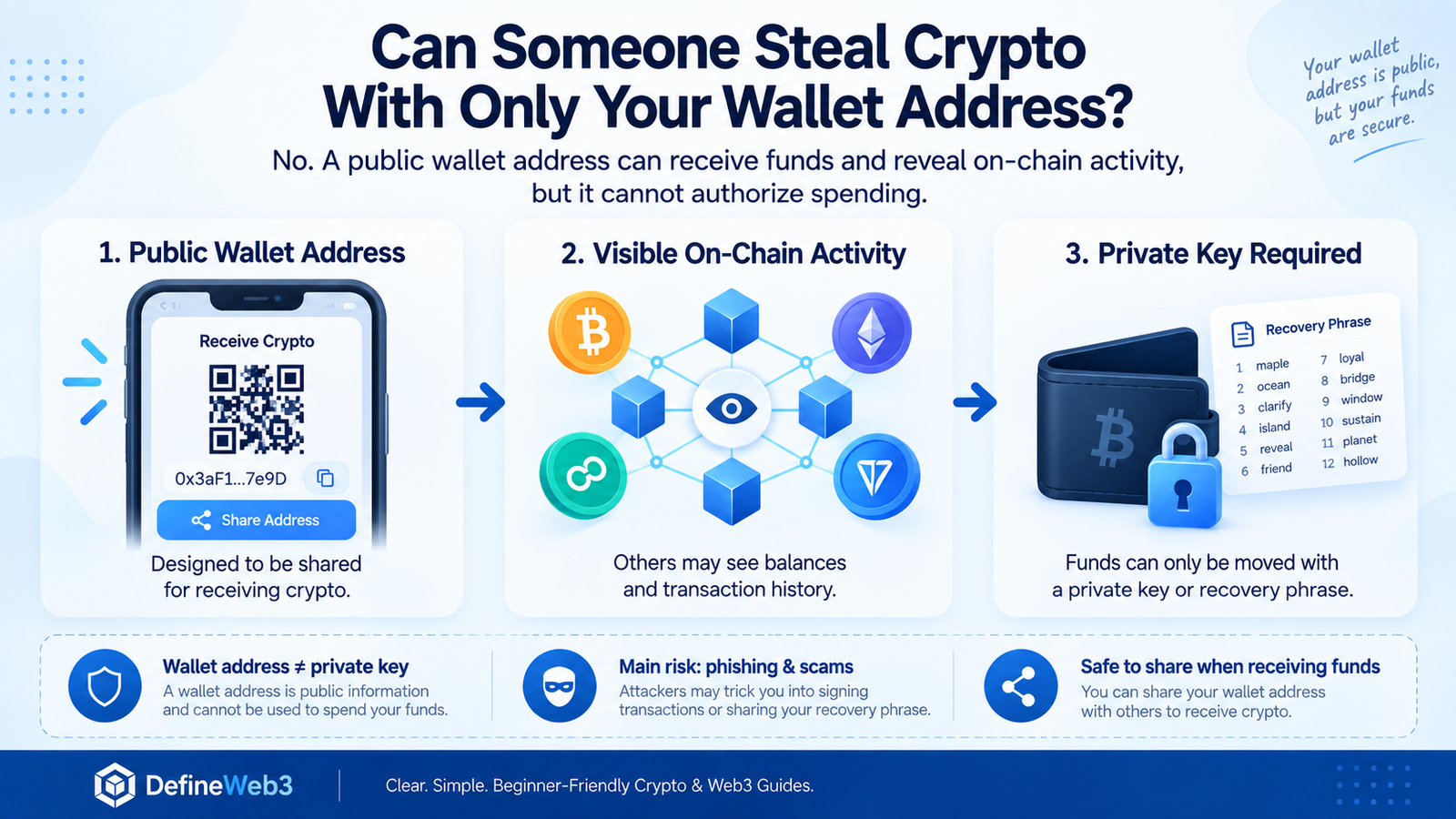
No. Someone cannot normally steal your cryptocurrency simply because they know your public wallet address.
A wallet address is designed to be shared so other people can send cryptocurrency to you. Knowing that address does not reveal the private key needed to authorize transactions from your wallet.
However, sharing a wallet address is not completely without consequences.
Depending on the blockchain, someone who knows your address may be able to view your balance, transaction history and interactions with other addresses. They could also use that public information to target you with phishing, fake tokens or other scams.
So the important distinction is:
Your wallet address alone does not give someone control of your crypto, but it can reveal information about your on-chain activity.
What Is a Crypto Wallet Address?
A crypto wallet address is a public identifier used to send and receive cryptocurrency.
Depending on the blockchain, it may look something like a long sequence of letters and numbers.
When someone wants to send you crypto, you give them the appropriate receiving address.
This is fundamentally different from your:
- Private key
- Recovery phrase or seed phrase
- Wallet password
- PIN
Those credentials should remain private.
Your public address is designed to be shared when receiving funds, unlike your private credentials.
What Can Someone Do With Your Wallet Address?
Although they cannot simply withdraw your crypto, someone who knows your address may still be able to do several things.
Send Crypto to Your Address
This is the primary purpose of a wallet address.
Someone can send supported cryptocurrency or tokens to it without needing access to your wallet application.
In fact, as we explained in our guide to receiving crypto while your wallet is offline, a wallet can receive an ordinary on-chain transaction even while the wallet itself is disconnected.
View Your Public Transaction History
Many popular blockchains operate as public ledgers.
For example, Ethereum explains that standard on-chain activity is publicly visible and that transactions associated with a public address can be analyzed.
Someone may therefore be able to see:
- Incoming transactions
- Outgoing transactions
- Transaction amounts
- Current or historical balances
- Tokens associated with an address
- Smart contracts the address has interacted with
- Other addresses it has transacted with
Exactly what is visible depends on the blockchain and the tools being used.
Monitor Future Activity
Once someone knows an address, they can potentially continue checking its publicly recorded activity.
This doesn’t give them control over the wallet.
It is primarily a privacy consideration.
What Can’t Someone Do With Only Your Wallet Address?
Knowing an ordinary public wallet address alone does not normally allow someone to:
- Sign transactions as you
- Withdraw your cryptocurrency
- Discover your private key
- Discover your recovery phrase
- Log into your wallet app
- Change your wallet password
- Transfer your funds to themselves
As Ledger explains, knowing your wallet address alone does not grant access to your funds.
Cryptocurrency transactions generally require authorization using cryptographic keys controlled by the wallet owner.
A public address does not contain the secret information needed to produce that authorization.
Think of it this way:
Wallet address → tells people where funds can be sent
Private key → provides control over the funds
The two should never be treated as equivalent.
Can Someone Find Your Identity From a Wallet Address?
Not necessarily, but this is where wallet privacy becomes more complicated.
A blockchain address usually does not automatically contain your name, home address or other traditional identifying information.
However, blockchain activity can be analyzed.
If you publicly post an address alongside your identity, receive funds from an account associated with you, or interact with services that can connect blockchain activity with identifying information, it may become easier to associate an address with you.
Ethereum describes standard blockchain addresses as pseudonymous rather than inherently private, because transaction relationships and patterns can still be analyzed.
This means:
Public address ≠ automatic identity disclosure
but also:
Public address ≠ complete financial privacy
For that reason, users should think carefully before permanently associating a high-activity wallet address with their public identity.
Can Scammers Target You If They Know Your Wallet Address?
Yes, but this is different from stealing crypto through the address itself.
A scammer who sees an active wallet may try to trick its owner into doing something unsafe.
Examples include:
- Fake wallet-support messages
- Phishing websites
- Malicious token approvals
- Fake airdrops
- Spam tokens
- Address-poisoning attacks
- Attempts to obtain a recovery phrase or private key
In these situations, the attacker still needs something beyond knowing your public address.
Their goal is generally to convince you to expose credentials or authorize something malicious.
What Is Address Poisoning?
Address poisoning is a good example of why knowing a wallet address can still be useful to an attacker even though it doesn’t directly give them access.
A scammer creates an address that looks similar to one you previously used and then sends a tiny or zero-value transaction involving your address.
The attacker’s address may then appear in your transaction history.
The scammer hopes that later you will copy the similar-looking address from your history instead of the legitimate destination and accidentally send funds to them.
MetaMask warns that users should verify the entire destination address, particularly the middle characters, rather than relying only on matching characters at the beginning and end.
Importantly, address poisoning does not mean that the attacker gained access to your wallet.
The scam works by trying to make the wallet owner send funds to the wrong address.
What If Someone Sends Random Tokens to Your Wallet?
Public addresses can receive transactions from anyone.
That means you may sometimes notice unknown tokens, NFTs or tiny transfers appearing in your wallet.
Their presence does not automatically mean your wallet has been hacked.
However, you should be careful about interacting with unsolicited assets.
Some spam tokens or NFTs may be designed to lead users toward malicious websites or other scams.
Don’t visit unknown websites, reveal your recovery phrase or sign unexpected requests simply because an unfamiliar asset appeared in your wallet.
Is It Safe to Share Your Wallet Address?
Generally, yes when you need someone to send cryptocurrency to you.
Ethereum’s official documentation explicitly says that users can share their receiving address with others.
But there is a difference between:
Security:
Can someone directly spend your crypto from knowing the address?
Usually no.
Privacy:
Can they potentially inspect blockchain activity associated with the address?
On many public blockchains, yes.
Therefore, you may choose not to publicly associate a frequently used wallet address with your real-world identity if privacy matters to you.
What Information Should You Never Share?
While public wallet addresses are designed to be shared, some wallet information should be treated very differently.
Never intentionally share your:
Recovery Phrase
Your seed or recovery phrase can provide control over the accounts generated from it.
Anyone obtaining it may be able to restore the wallet elsewhere.
Private Key
A private key is used to authorize control of a blockchain account.
It should never be published or sent to someone claiming to provide customer support.
Wallet Password or PIN
Although passwords and PINs work differently from blockchain private keys, they should also remain confidential.
And remember: deleting your crypto wallet app does not necessarily delete your crypto from the blockchain, but losing the only usable recovery information can result in losing access.
What Should You Do If You Already Shared Your Wallet Address?
Usually, nothing needs to be done simply because you shared a public receiving address.
Sharing the address does not mean you need to move your funds or create a new wallet.
Instead:
- Keep your private key private.
- Never share your recovery phrase.
- Be suspicious of unsolicited wallet-support messages.
- Verify destination addresses before sending.
- Avoid connecting your wallet to unknown websites.
- Carefully review transaction and signature requests.
- Remember that public blockchain activity may be visible to others.
If you accidentally exposed a private key or recovery phrase, however, that is fundamentally different from sharing a wallet address and should be treated as a potential wallet compromise.
Frequently Asked Questions
Can someone hack my wallet if they know my address?
Knowing the public address alone normally does not provide the private key required to control your funds.
However, someone could potentially use information visible from that address to target you with scams or social-engineering attempts.
Can someone withdraw crypto with my wallet address?
No. A public wallet address alone does not provide the authorization required to send cryptocurrency out of the wallet.
Can someone see how much crypto I own from my wallet address?
On transparent public blockchains, someone may be able to inspect balances and transaction activity associated with an address using a blockchain explorer. Ethereum notes that standard on-chain transactions are publicly recorded and can be analyzed.
Is my wallet address the same as my private key?
No.
Your public wallet address is designed to be shared. Your private key is secret information used to control the account.
Never share your private key.
Should I change my wallet if someone knows my address?
Not simply because someone knows your public address.
You may choose to use different addresses or accounts for privacy reasons, depending on the blockchain and wallet, but knowing an address alone does not mean the wallet has been compromised.
Final Takeaway
Someone cannot normally steal your crypto using only your public wallet address.
A wallet address is meant to be shared so that other people can send cryptocurrency to you. It does not reveal the private key required to authorize outgoing transactions.
However, public does not mean private.
On transparent blockchains, your address can reveal transaction history, balances and relationships with other addresses. That information can potentially make you a target for phishing, address poisoning and other scams.
The easiest rule to remember is:
Wallet address: okay to share when necessary.
Private key or recovery phrase: never share.