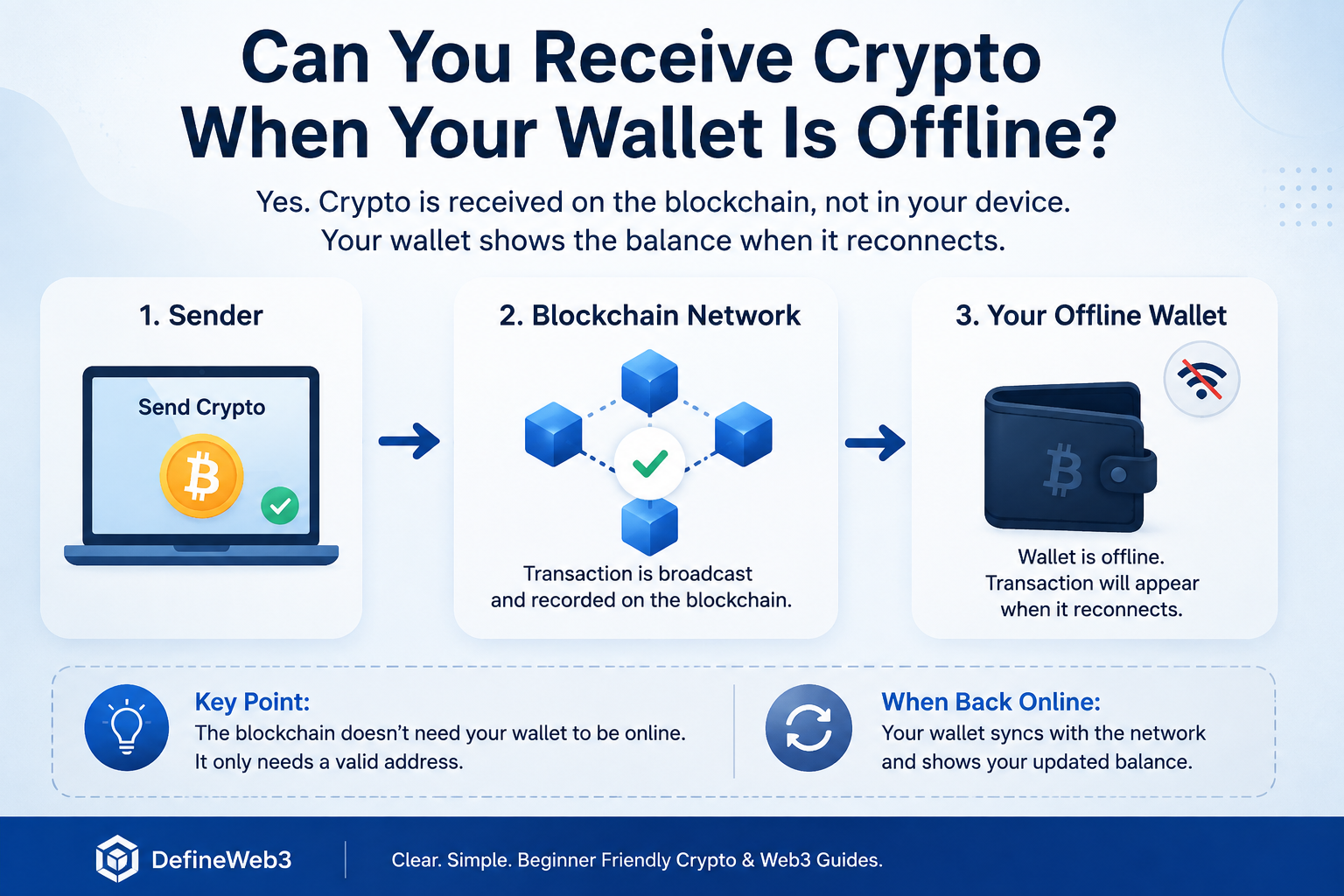
Yes. You can receive cryptocurrency even when your wallet is offline, as long as someone sends the funds to a valid address on the correct blockchain network.
Your phone does not need to be turned on, your wallet app does not need to be open, and a hardware wallet does not need to be connected for an ordinary on-chain transaction to reach your address.
That is because cryptocurrency is not physically stored inside your wallet app or hardware device. The blockchain records the transaction, while your wallet gives you access to the keys needed to control the funds.
Bitcoin.org specifically confirms that Bitcoin can be received while a computer running the wallet is powered off. The wallet simply detects the transaction when it reconnects and synchronizes with the network.
How Can a Crypto Wallet Receive Funds While Offline?
Bitcoin.org confirms that Bitcoin can still be received while the wallet software is offline.
The easiest way to understand this is to stop thinking of a crypto wallet like a traditional bank account app.
When someone sends crypto, the process is roughly:
Sender → Blockchain network → Your crypto address
The transaction does not need to travel directly into your phone or hardware wallet.
Suppose you previously generated a Bitcoin receiving address and gave it to someone. You could then:
- close the wallet application,
- turn your phone off,
- disconnect your computer,
- or put your hardware wallet away.
If the sender later transfers Bitcoin to that valid address, the Bitcoin network can still process and record the transaction.
Ledger similarly explains that crypto assets exist on the blockchain, while the hardware device protects the private keys that give the owner control over those assets.
Does a Crypto Wallet Need Internet to Receive Crypto?
For a standard on-chain transaction, the wallet itself does not need to be connected to the internet at the moment the transaction occurs.
The network needs functioning blockchain nodes to process and record the transaction, but your personal wallet application doesn’t have to be online.
An internet connection becomes necessary when the wallet needs to:
- retrieve updated blockchain information,
- display the latest balance,
- check transaction confirmations,
- or broadcast a transaction when you want to send crypto.
So if someone sends you cryptocurrency while your wallet is offline, you may not see the new balance immediately.
Once the wallet reconnects and obtains updated blockchain data, the transaction should appear.
Can a Hardware Wallet Receive Crypto While Disconnected?
Yes. A hardware wallet such as a Ledger does not have to remain connected for you to receive an ordinary on-chain transaction.
The important thing is having a valid receiving address that belongs to the wallet.
For example, Ledger explains that users generate a receiving address through its wallet application and verify that address using the hardware device. Once you have verified an address, another person can send Bitcoin to it.
The hardware device primarily protects your private keys.
It is not a container that cryptocurrency has to physically enter.
This distinction is one of the most important concepts for beginners to understand about crypto wallets.
What Happens When You Bring the Wallet Back Online?
When you reopen your wallet application, it connects to the relevant blockchain infrastructure and obtains updated information about your addresses.
The application can then discover that a transaction was sent while you were offline.
Your interface may show:
- the incoming transaction,
- the amount received,
- confirmation status,
- and your updated balance.
With some wallets, this happens almost immediately. Other wallets or full-node software may need more time to synchronize.
Bitcoin.org describes the same process for Bitcoin: transactions received while the wallet software is not running become visible when the wallet later catches up with the blockchain.
Does the Wallet App Need to Be Open to Receive Crypto?
Usually, no.
For normal blockchain transfers, closing your wallet application does not prevent someone from sending funds to an existing valid address.
For example, if you copy an Ethereum, Bitcoin, or Solana address and then close the application, that address does not normally stop existing simply because the app isn’t running.
Your wallet software is an interface for interacting with the blockchain and managing your keys. It does not have to remain open waiting for cryptocurrency to arrive.
Can You Receive Bitcoin While Your Phone Is Turned Off?
Yes.
If you have already provided the sender with a valid Bitcoin address, your phone can be completely powered off when the sender makes the transaction.
Bitcoin nodes continue operating independently of your phone.
When you later open your Bitcoin wallet and it reconnects to the network, it can detect the transaction.
The same basic concept applies to many other on-chain cryptocurrency transfers, although individual networks and wallet implementations can work differently.
Is Lightning Different?
Yes, and this distinction is important.
Lightning payments work differently from normal on-chain transactions because they use payment channels rather than recording every payment directly on the Bitcoin blockchain.
Receiving Bitcoin on-chain while your wallet is offline is different from receiving a payment through the Bitcoin Lightning Network.
Lightning payments move through payment channels rather than being recorded individually as normal Bitcoin blockchain transactions.
Lightning Labs documentation states that for a traditional Lightning payment, the participating peers and routing nodes generally need to be online while the transaction takes place. Mobile Lightning wallets may therefore need to remain active until the payment settles.
Some wallet services can provide different approaches to managing Lightning connectivity, so you should check the requirements of the specific Lightning wallet you use.
What Should You Check Before Someone Sends Crypto?
Being offline normally isn’t the biggest risk when receiving crypto. Using incorrect transaction details is much more important.
Before receiving a transfer, check:
- Wallet address: Make sure the receiving address is correct.
- Blockchain network: Confirm that the sender is using the network your wallet supports.
- Asset: Check that the wallet supports the cryptocurrency or token being sent.
- Memo or destination tag: Some networks, exchanges and custodial services require additional information.
- Address verification: When using a hardware wallet, verify important receiving addresses on the hardware device when possible.
For Bitcoin, address accuracy is particularly important because confirmed transactions generally cannot simply be reversed. Bitcoin.org recommends verifying the full receiving address rather than relying only on a few beginning and ending characters.
Frequently Asked Questions
Can someone send Bitcoin to me while my phone is off?
Yes. If they have a valid Bitcoin address belonging to your wallet, the Bitcoin network can record the transaction while your phone is switched off.
Will my crypto balance update while the wallet is offline?
The blockchain can record the transaction, but your wallet application may not display the new balance until it reconnects and retrieves updated information.
Does a Ledger need to stay connected to receive crypto?
No. A Ledger device doesn’t generally need to remain connected for an on-chain payment to be sent to an address you previously generated and verified.
Can someone send crypto while my wallet app is closed?
For ordinary on-chain transactions, yes. Your wallet app doesn’t usually need to be running for someone to send crypto to an existing valid address.
Can I receive crypto if I delete my wallet app?
Potentially yes, because deleting an application does not erase transactions from the blockchain. However, recovering access to the wallet is a separate issue, and that will be important enough for our next guide.
Final Takeaway
Your crypto wallet does not need to be continuously online to receive standard on-chain cryptocurrency transactions.
The blockchain records the transaction. Your wallet provides the keys and interface that allow you to access and manage those funds.
So if your phone is off, your hardware wallet is disconnected, or your wallet application is closed, someone can generally still send crypto to a valid address you already control.
Just remember that off-chain systems such as the Lightning Network can work differently, and always verify the receiving address, network and asset before a transfer.